Trump Signs Order for Government Reviews of Advanced AI Models Before Release
06/06/2026 / By Chase Codewell

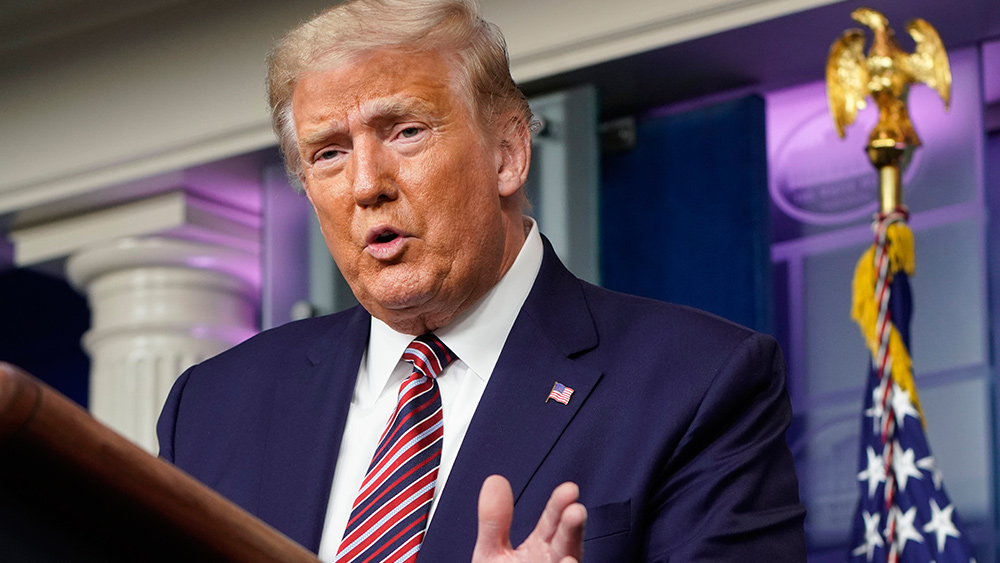
President Donald Trump signed an executive order on June 2 requiring certain artificial intelligence (AI) companies to voluntarily submit their most advanced frontier models to the federal government for review before public release.
The order, signed without the usual public ceremony, is intended to address cybersecurity and national security risks posed by increasingly powerful AI systems, according to the White House. [1] [2]
Under the order, companies may provide the government access to cutting-edge AI models up to 30 days before deployment. A previous draft had called for a voluntary review period of 90 days, but the timeline was shortened after objections from industry executives. Officials said the measure is designed to assess safety and security risks without imposing mandatory licensing requirements that could slow U.S. competitiveness. [1][3]
The signing followed a delay from May, during which Trump told reporters he “didn’t like certain aspects” of the earlier version and postponed the action. [4][3]
Scope of Voluntary Testing
The executive order directs multiple federal agencies to strengthen protections for critical infrastructure. The Department of War (DoW), Department of the Treasury (DoT), and Cybersecurity and Infrastructure Security Agency are tasked with working alongside leading AI firms such as OpenAI, Anthropic, and Google on voluntary safety evaluations. Companies choosing to participate would allow officials to test models for potential security vulnerabilities before public release. [1][5][6]
The order also establishes an AI cybersecurity clearinghouse to share information about software vulnerabilities across the government. The Department of Justice (DoJ) is directed to prioritize prosecutions involving AI-related cybercrime and the misuse of autonomous AI systems. [6]
These actions build on earlier voluntary agreements between AI companies and the United States Department of Commerce (DOC) during the Biden administration, including pacts with Google, Microsoft, and xAI. [7]
The Trump administration has also previously moved to centralize federal AI policy, issuing a legislative framework in March that would preempt state AI laws. [8]
Key Quote and Reactions
The executive order states: “Advanced AI capabilities make our Nation stronger, but also introduce new national security considerations that require coordinated action across executive departments and agencies.” [6] The order was signed privately, and no immediate public statements were released by major AI companies in response to the signing.
The delay from May was attributed in part to lobbying by tech executives, including Elon Musk, Meta CEO Mark Zuckerberg, and former Trump AI adviser David Sacks, who reportedly expressed concern that earlier versions could hinder U.S. firms competing with China. Musk denied influencing the decision, stating on X: “I still don’t know what was in that [executive order] and the president only spoke to me after declining to sign.” [9][10]
Trump himself had said the United States is “leading China” in AI and did not want to “do anything that’s going to get in the way of that leading.” [10] The voluntary nature of the final order avoids mandatory licensing, which some industry groups had opposed. [11]
Implications and Context
The order reflects the administration’s balancing of two priorities: fostering AI innovation and addressing national security risks. Official sources said the voluntary approach aims to avoid hindering U.S. competitiveness while still allowing the government to assess potential dangers from frontier models. [1][6]
Analysts have noted that the order stops short of the mandatory frameworks considered by some states, such as California’s SB-1047, which would have imposed stricter requirements on developers. [12]
Broader concerns about AI’s societal and security risks continue to intensify. Corporate leaders have warned that AI-driven automation could eliminate up to half of all entry-level white-collar jobs within five years. [13]
The Health Ranger Mike Adams has also warned that AI poses dual threats of censorship and depopulation risks, calling for decentralized alternatives. [14]
Additionally, the surging energy demands of AI data centers have prompted the U.S. government to declare a national emergency and plan purchases of nuclear reactors. [15] The order also aligns with a broader push to ensure that AI systems meet standards of “truthfulness and ideological neutrality” in federal use, as outlined in a previous executive order. [16]
Conclusion
The executive order signed by Trump marks a measured step toward federal oversight of advanced AI, emphasizing voluntary participation and security review without heavy-handed licensing. As policymakers continue to grapple with the rapid evolution of AI capabilities, the order is likely to be seen as a compromise between innovation and precaution.
The Justice Department’s new focus on AI-related crime and the creation of a cybersecurity clearinghouse signal that further government engagement with the technology is expected.
The impact of the order will depend on the degree to which major AI companies choose to participate and how effectively federal agencies implement the review processes. [2][7]
References
- TechCrunch. “Trump signs narrower executive order on AI oversight after industry objections.” June 2, 2026.
- Just the News. “Trump signs AI executive order urging oversight of new models.” June 2, 2026.
- The Epoch Times. “Trump Postpones Executive Order on AI.” May 21, 2026.
- Just the News. “Trump delays signing executive order on AI: ‘didn’t like certain aspects of it’.” May 22, 2026.
- NTD. “Trump Signs AI ‘Cyber Defense’ Executive Order.” June 2, 2026.
- The National Pulse. “Trump Signs Order for Government Reviews of Advanced AI Models Before Release.” June 2, 2026.
- BBC News. “US to safety test new AI models from Google, Microsoft, xAI.” May 5, 2026.
- TechCrunch. “Trump’s AI framework targets state laws, shifts child safety burden to parents.” March 20, 2026.
- NaturalNews.com. “Trump Delays AI Oversight Order Amid Concerns Over Competition, Lobbying Reports.” May 27, 2026.
- TechCrunch. “Trump delays AI security executive order: ‘I don’t want to get in the way of that leading’.” May 21, 2026.
- 100percentfedup.com. “President Trump Signs Executive Order to Keep America First in AI Without Biden-Style Mandates.” June 2, 2026.
- Trends-Journal-2024-08-27.
- Patrick Lewis. “AI apocalypse: CEOs warn of job destruction, rogue AI threatens humanity.” NaturalNews.com. March 15, 2026.
- Finn Heartley. “Health Ranger warns of AI’s dual threats and solutions.” NaturalNews.com. October 8, 2025.
- NaturalNews.com. “US declares national emergency, plans to buy 10 nuclear reactors using Japan’s $550 billion pledge.” November 21, 2025.
- Laura Harris. “Trump signs order banning woke AI, mandates ideological neutrality in federal tech use.” NaturalNews.com. July 26, 2025.
- Trump Signs Order for Government Reviews of Advanced AI Models Before Release. TheNationalPulse.com. June 2, 2026.
Submit a correction >>
Tagged Under:
AI, AI bubble, AI models, artificial intelligence, big government, Big Tech, bubble, collapse, computing, current events, cyber security, data center, future tech, glitch, information technology, national security, OpenAI, pentagon, robots, tech giants, Trump, White House
This article may contain statements that reflect the opinion of the author
RECENT NEWS & ARTICLES